Choosing between a coworking space and a traditional office depends on factors such as cost, flexibility, privacy, control, location and the way your team works.
A coworking space typically provides a flexible workspace with shared facilities, services and membership options, while a traditional office gives a business dedicated space with greater control over its layout, branding and day-to-day environment.
So, what is the difference between a coworking space and a traditional office? The main differences come down to flexibility, cost structure, privacy, customisation, scalability and management responsibilities. Understanding these factors can help you determine which type of workspace fits your business requirements.
Coworking Space vs Traditional Office
The main difference between coworking spaces and traditional offices is the way businesses access, manage and pay for their workspace.
| Factor | Coworking Space | Traditional Office |
|---|---|---|
| Cost | Usually involves a membership or flexible workspace fee | Usually involves rent, utilities, setup and maintenance costs |
| Flexibility | Flexible plans and workspace options | Generally longer-term commitments |
| Scalability | Easier to add or reduce workspace | Changes may require relocating or renegotiating space |
| Privacy | Depends on the workspace; private offices may be available | Greater control over private areas |
| Customisation | Usually more limited | Greater control over design and branding |
| Amenities | Often included as part of the membership | Usually arranged and managed by the business |
| Management | Many operational services are handled by the provider | Business generally manages the office directly |
| Networking | Opportunities to interact with other businesses and professionals | Primarily focused on internal teams and visitors |
| Location | Can provide access to established business locations | Business chooses and controls its dedicated premises |
| Best suited to | Businesses prioritising flexibility and managed workspace | Businesses needing dedicated space and greater control |

What Is the Difference Between Coworking and Traditional Offices?
What Is a Coworking Space?
A coworking space is a shared workspace where individuals, startups, freelancers and businesses work within a professionally managed environment. Members may have access to desks, private offices, meeting rooms, high-speed internet, reception services and other workplace amenities.
Coworking spaces typically offer different membership or workspace options, allowing businesses to choose a setup based on their team size and working requirements.
What Is a Traditional Office?
A traditional office is a dedicated workspace occupied and managed by a single business or organisation. The company generally has greater control over the office layout, branding, privacy, facilities and day-to-day working environment.
Traditional offices can provide greater stability and customisation, but businesses may also have more responsibility for rent, utilities, maintenance, furniture, technology and other operational requirements.
Pros of Co-working Spaces
Even though the specific occupations are not specified, one may easily consider a simple image of a building where different people, including professionals of any field, meet to work and cooperate.
This is not a regular working environment but an active and multifaceted platform called a co-working office. It is alive and full of vigour, and people of all types jog in and out of buildings in a rhythmic fashion.
Now, the first point of discussion is the advantages of co-working spaces.
-
Flexibility and Scalability
Efficiency is an interesting feature that many people also consider as the biggest strength of a co-office. They commonly have different choices of memberships, such as hot desks and private offices. This flexibility enables organisations to expand or contract more easily depending on the current needs.
-
Networking Opportunities
Co-working spaces refer to the arrangement of workstations in such a manner that there is a shared working area for various professionals regardless of the field they may be from. It also creates good circumstances for formal or informal interactions with other people that may result in partnership, cooperation or the acquisition of new clients.
-
Cost-Effectiveness
For startups and growing businesses, coworking spaces can reduce some of the upfront costs associated with setting up a traditional office. Furniture, internet, meeting rooms and other workplace services may be included depending on the provider and membership.
-
Amenities and Services
Most co-working spaces provide various facilities and utilities, high-speed internet, meeting rooms and even reception services and a wellness area. If properly implemented, the following perks will improve the productivity of your staff without necessarily having to dig deeper into your pocket.
-
Location Benefits
Coworking spaces are often available in established business locations, giving startups and small businesses access to professional addresses and convenient transport connections without necessarily taking on a dedicated traditional office.
Cons of Co-working Spaces
Co-working spaces have their advantages and demerits, as highlighted below. Rather than that, these shared working spaces, as effective and popular as they have been introduced, are not suitable for any business or personality.
Some employees in co-working office spaces state that the environment is not friendly to privacy and concentration. Workers who feel most comfortable in a fast-paced environment see the surroundings as stimulating, while others feel there are too many distractions.
Furthermore, it is not easy to deal with matters related to the failure to be in charge of the surrounding working environment and space limitations, especially during rush hours.
-
Limited Privacy
Although co-working spaces often contain private offices, the nature of these structures is generally more organismic, which sometimes can pose privacy issues. In general spaces, people may find it difficult to have serious private discussions or do work that requires privacy.
-
Potential Distractions
The environment of a co-working space is rich and energetic; however, an excessive number of stimuli are present. Select team members might not be able to focus well because the setting is open and there are other people around.
-
Lack of Customisation
However, co-work spaces are often constrained in the level of decoration and branding of the area that is offered. It may also prove difficult for the workplace to build its own culture or spirit within the business.
-
Uncertain Availability
Well-known co-working spaces or those on the higher end of the market might require that you book well in advance, especially if you are looking for exclusive offices or meeting rooms. Lack of the necessary tools/ equipment when they are supposed to be used may compromise your team’s workflow.

Pros of Traditional Offices
Conventional working arrangements have been the framework for corporate life for quite some time now. These offices commonly include workspaces for employees, divided into separate workstations or sometimes separate offices, meeting rooms and receptions, and sometimes cafeterias or kitchens.
Take a look at the benefits of traditional office:
-
Brand identity and Customisation
An ordinary office environment enables one to build structures that depict the company’s corporate identity. The layout of the office, other electrical fixtures, and even draperies can reflect your company’s goals and organisational culture.
-
Privacy and Security
Conventional workplaces offer more privacy and security than open arrangements. This is especially true for firms that handle sensitive information or those in regulatory-specific industries.
-
Stability and Permanence
The definition of having one’s own workspace offers a degree of legitimacy for the team. In that it can go a long way in propelling employees’ feeling of being fully proprietorial and/or committed to the organisation.
-
Control Over the Work Environment
The work environment is another factor affected by management control. One cannot underestimate the fact that in a traditional office environment, one is an absolute king as far as work input is concerned. This way, you can arrange the space to optimise its usage and your business’s requirements are equally accommodated.
-
Client Impressions
For companies that entertain clients often, a well-maintained traditional office appearance is desirable. It indicates that they are stable and successful, which is good for developing client relations.
Cons of Traditional Offices
Even though conventional workplaces provide organisation, structure, and predictability, they also entail certain obstacles. This is because most business requirements, such as, offering products or services, entail making huge investments, often at the beginning, to secure long-term leases.
It has been observed that these spaces often do not have the freedom to grow or shrink as the company’s needs may change in the future. Offices in the conventional traditional style of setting require much time and effort to maintain and manage.
Also, fixed locations can compromise clients’ or talent’s diversification and may require talent to travel more to the workplace. These disadvantages have made many organisations start questioning the traditional office structure and seek other types of working environments.
-
Limited Flexibility
Thus, conventional offices possess certain disadvantages; in particular, they are not as flexible as co-working spaces. Expanding or reducing production can be dicey, and the firm is likely to suffer some losses in the process.
-
High Costs
The rent and maintenance of a conventional office can be rather costly. Expenses pertain to the lease, electricity, water, technology, machinery, and other necessities to maintain office machines, among other things.
-
Long-Term Commitments
Typical commercial leases are long-term, and signing such an agreement implies a certain level of business stability; however, it does not always fit start-ups or industries with fluctuating demand.
-
Responsibility for Management
In a traditional office, the business bears all the costs relating to its management. This basically involves sanitation, property maintenance, utility control, and other services such as the Internet.
-
Opportunities to use additional square metres
If your team is often distributed or your enterprise is seasonal, you may rent space that is not needed at a given time.
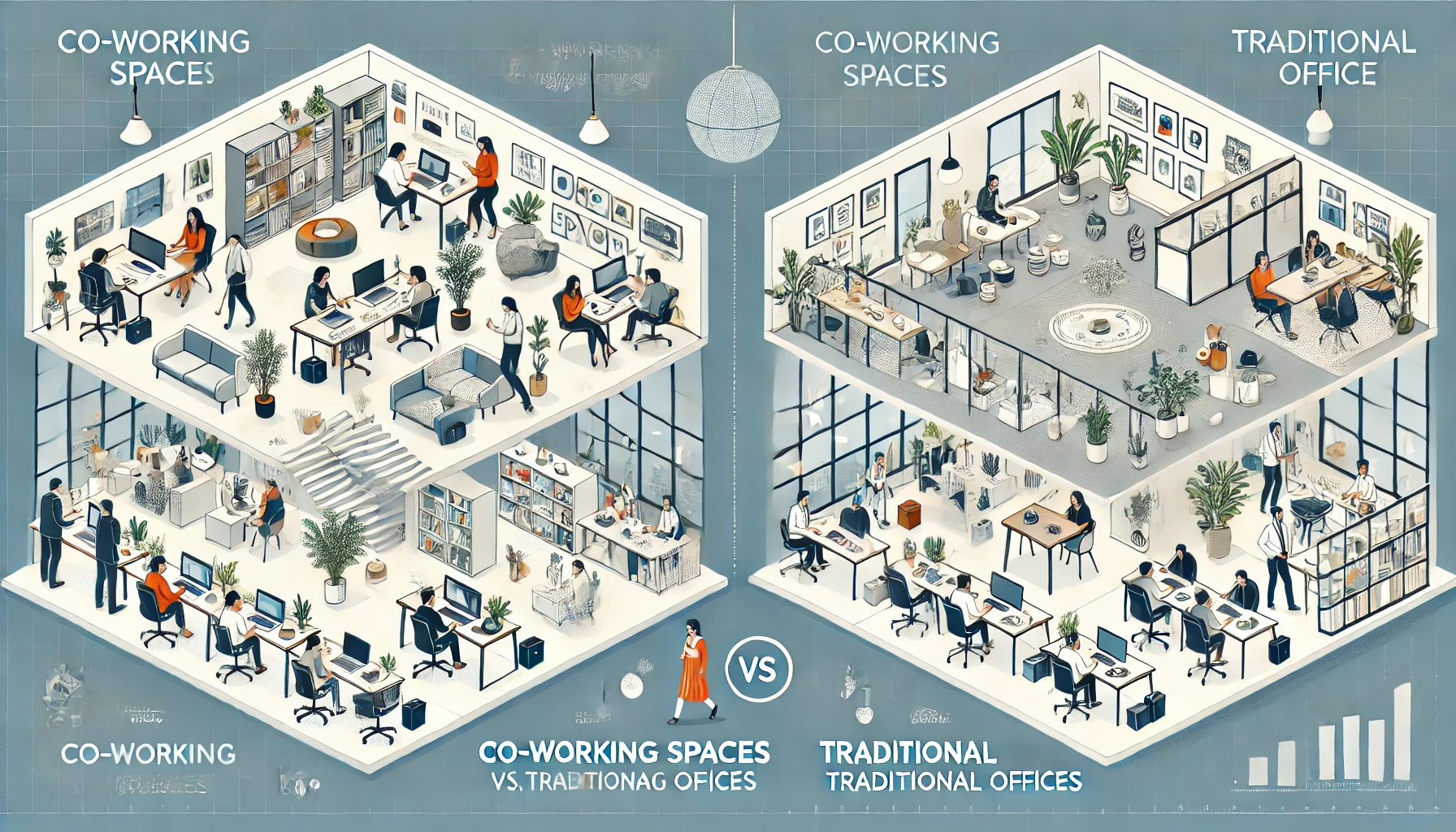
Comparative Analysis of Co-working Spaces vs. Traditional Offices
When comparing co-working office spaces and traditional offices, several factors come into play. Here’s a breakdown of how they stack up against each other:
-
Cost Efficiency
It is important to note that co-working spaces cost less in the short run for lower-ranking new business entities such as start-ups. They bypass the need for significant and usually expensive initial payments and allow for more long-term payment plans.
However, there is a time when a company expands and realises that managing an office physically could be cheaper.
-
Flexibility and Scalability
The respondents were also of the opinion that co-working spaces came out on top in terms of flexibility. They enable business organisations to adapt easily to changes in space use.
While giving teams stability and structure, traditional offices may prove less flexible regarding frequently occurring changes in team dynamics.
-
Culture & Brand
Conventional offices afford more possibilities for creating an organisational culture or a consistent brand image through design and disposition. Although co-working spaces are lively, they may pose some problems when it comes to building a company culture.
-
Networking and Collaboration
Co-working spaces are good for networking since they offer a collaborative working atmosphere. Although offices may restrict external communication, internal communication and employee bonding could be enriched.
-
Privacy and Security
Important information firms share is much more secure in traditional business offices. While highlighting the difference between co-working spaces and open offices, there is often an option to rent an individual working space, yet the level of confidentiality remains invulnerable.
-
Work-Life Balance
Co-working spaces explicitly help structure one’s working day and are, therefore, appropriate for freelancers or remote workers. A typical regular working office, particularly if designed ineffectively, could distort these differences more.
-
Professional Image
Despite this, both options can present a business-like look, but they will be different. Permanent and tailored to the needs, a traditional office might pleasantly meet the client’s expectations. A successful conventional office can give small businesses or start-ups the image they need.
-
Amenities and Services
In the case of co-working spaces, most services listed are usually bundled under membership fees. In a traditional office environment, these would have to be set up and coordinated differently.
-
Location
Co-working spaces often provide access to prime locations that might be unaffordable for small businesses in a traditional office setting. However, established companies might prefer to have control over the location that comes with leasing a traditional office.
Conclusion
The choice between a coworking space and a traditional office depends on how your business operates and what it needs from its workspace.
Coworking spaces can provide flexibility, shared amenities and scalable workspace options, while traditional offices can offer greater privacy, customisation and control over the working environment.
When comparing the two, consider your budget, team size, expected growth, privacy requirements, location, workspace control and long-term plans. For some businesses, a dedicated office may make sense; for others, a flexible coworking arrangement may better match their current requirements. A hybrid approach can also combine dedicated workspace with flexible options when business needs vary.