The way businesses use office space is changing. Companies increasingly need flexible, fully equipped workplaces that can support growth without the complexity of traditional office leases.
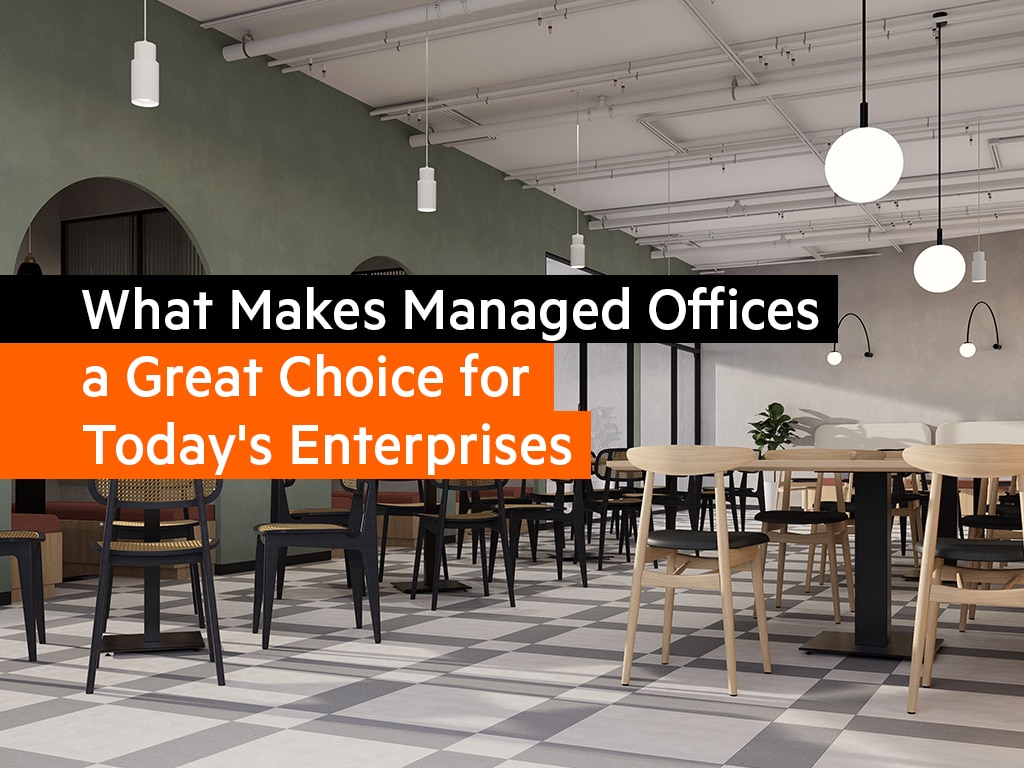
A managed office is a fully equipped and professionally operated workspace managed by a third-party provider. It typically includes office interiors, furniture, IT infrastructure, utilities, housekeeping, maintenance and other day-to-day services. This allows businesses to move in quickly while leaving office operations to the provider.
For growing companies, enterprises and Global Capability Centres (GCCs), a managed workspace combines the privacy and branding of a dedicated office with the flexibility and operational support of a professionally managed facility.
What Is a Managed Office?
A managed office is a fully equipped, professionally operated, ready-to-move-in workspace that is set up and managed by a third-party provider. Unlike a traditional office lease, where businesses are responsible for everything from interiors and furniture to IT infrastructure, utilities, cleaning and maintenance, a managed office transfers these operational responsibilities to the provider. In simple terms, it is a plug-and-play workspace where businesses can start working from day one while the provider handles the day-to-day operations.
The managed office sits in a distinct position in the workspace market — different from both traditional leases and standard coworking spaces. Managed office spaces are fully integrated, enterprise-grade workspace ecosystems designed, delivered, and operated by third-party providers. They combine the privacy and branding of dedicated office spaces with the operational flexibility and convenience of a serviced office.
This hybrid character is what makes the managed office so appealing for enterprises. You get a space that feels entirely yours — your branding, your team, your culture — without any of the overhead of building and running it yourself.
It is also worth distinguishing a managed office from a serviced office. Both are professionally run and fully equipped, and the terms are sometimes used interchangeably. The key distinction lies in customisation and scale. A serviced office typically provides standardised, ready-made individual offices or suites within a shared business centre — ideal for small teams and solo professionals who need a professional base quickly. A managed office, by contrast, is usually a larger, more bespoke arrangement where the provider designs, builds, and operates a dedicated space tailored specifically to the occupying company’s requirements. Think of a serviced office as a furnished apartment you move into as-is, and a managed office as a fully staffed home that has been designed and fitted out specifically for your family.
Managed Office Solutions for Modern Businesses
Managed office solutions provide businesses with a ready-to-use workplace along with the infrastructure and operational services needed to run it. Depending on the provider and business requirements, solutions can include customised office design, furniture, IT infrastructure, meeting rooms, reception services, housekeeping, security and ongoing facility management.
These solutions are particularly useful for enterprises that need to establish offices quickly, expand across cities or create a professional workspace without managing every aspect of the setup themselves.
Benefits of Managed Office Spaces
The key managed office benefits include faster setup, predictable costs, enterprise-grade infrastructure, flexibility and reduced operational complexity.
1. Immediate Operational Readiness
Time is one of the most valuable resources any enterprise manages. Setting up a traditional office — finding the space, negotiating the lease, managing the fit-out, procuring furniture and IT, hiring support staff — can take months and consume enormous management attention. A managed office eliminates this timeline entirely.
Traditional setups can take weeks or even months to become operational. Managed offices allow companies to start operations faster, avoid delays in hiring or onboarding, and maintain business momentum from day one.
For an enterprise opening a new city office or establishing a GCC, this speed advantage directly translates into revenue impact and competitive positioning.
2. Significant Cost Efficiency and Predictable Budgeting
Capital expenditure on office setup is one of the largest single costs a growing enterprise faces. Fit-out costs, security deposits, furniture procurement, IT infrastructure, and the ongoing costs of managing vendors and support staff all add up to a substantial financial commitment — much of it before the first employee walks through the door.
The transition from capital expenditure (CapEx) to operational expenditure (OpEx) is one of the biggest and most important benefits of managed offices. Businesses can improve their finances with flexible lease terms, predictable monthly costs, and the ability to scale up or down as needed, largely avoiding upfront investments.
Managed office spaces provide 80% of the benefits at 40% of the cost — saving businesses time, money, and operational headaches compared to traditional office setups. This is not a small margin. It represents a fundamental shift in how workspace capital is deployed.
3. Enterprise-Grade Infrastructure Without the Management Burden
A well-run managed office does not ask enterprises to compromise on quality in exchange for convenience. The technology and physical infrastructure in premium managed office and serviced office facilities is purposely built for serious business operations.
The technology backbone of managed office spaces delivers enterprise-level capabilities that most businesses could not afford or manage independently — secure Wi-Fi networks with separate guest and business access, meeting-room AV systems that eliminate awkward connectivity issues, professional video conferencing, wireless presentation capabilities, and crystal-clear audio systems.
IT support, maintenance, security, housekeeping, and reception services are all handled by the provider. For IT and operations teams, this means no more chasing internet vendors, coordinating with repair technicians, or managing pantry vendors. Managed spaces provide centralised support, enterprise-grade tech infrastructure, and on-call troubleshooting, so internal teams can focus on scaling core systems rather than fixing facility problems.
4. Flexibility to Scale With Your Business
Enterprise workforce numbers are not static. Project teams expand, new departments form, market conditions shift. In a traditional office with a fixed lease, this dynamism becomes a liability — you end up either squeezed into a space that is too small or paying for a space that is too large.
Managed offices offer flexible lease terms, the ability to scale up or down, and options to expand within the same building or network. This flexibility reduces the risk of being stuck in a space that no longer fits your team.
Managed offices also offer shorter, more flexible leases than traditional office leases. These spaces can be adapted based on business needs, be it for six months or two years. As the company expands, it becomes easy to add office spaces simultaneously.
For enterprises running large, distributed operations or GCCs, this scalability is not a minor convenience — it is a strategic operational advantage.
5. Professional Brand Presence and Employee Experience
A managed office is not just a desk and a WiFi password. Premium providers design spaces that are visually impressive, professionally branded, and deliberately engineered to support employee wellbeing and productivity.
Your branded reception area becomes your company’s first impression. Instead of directing clients to a shared space, they walk into an area that reflects your brand — your logo on the wall, your colours in the design, your identity in every detail.
HR teams benefit by delivering better employee experiences without worrying about daily logistics. Managed spaces come with well-being zones, modern breakout areas, and professional meeting spaces — all of which contribute to higher retention and workplace satisfaction.
In a talent market where the quality of the work environment is a genuine factor in recruitment and retention decisions, a well-designed managed office gives enterprises a meaningful edge.
6. Multi-City and Multi-State Expansion Without Real Estate Complexity
For enterprises growing across India’s cities or establishing presence in multiple states, the traditional approach — negotiate leases, manage fit-outs, hire local facility teams in each market — is slow, expensive, and operationally complex.
The managed office model simplifies this dramatically. Leading providers operate across multiple cities with standardised quality and consistent infrastructure. An enterprise can open offices in Bangalore, Mumbai, Delhi, and Hyderabad within the same quarter without managing a single vendor relationship outside of its provider.
Managed offices operate as operational expenses with shorter approval cycles, which means faster decisions and quicker market responses. For enterprise clients, it is about agility without sacrificing professionalism.
7. Freedom to Focus on Core Business
Perhaps the most undervalued benefit of the managed office model is what it gives back to enterprise leadership teams: attention. Every hour spent managing office maintenance, vendor contracts, facility compliance, or infrastructure problems is an hour not spent on strategy, customers, and growth.
IT infrastructure, maintenance, security, housekeeping, compliance, and other management layers are all part of running an office. Since managed office providers take full responsibility for these tasks, organisations can lower administrative complexity, increase operational effectiveness, and fully concentrate on their core business operations.
FAQs
What Is a Managed Office?
A managed office is a fully equipped and professionally operated workspace provided and managed by a third-party provider. The provider typically handles the office setup, furniture, IT infrastructure, utilities, maintenance, housekeeping and other operational services, allowing businesses to move into a ready-to-use workspace with less administrative effort.
What Is a Managed Workspace?
A managed workspace is an office environment where the workspace provider takes responsibility for the facilities and day-to-day operations. Businesses can use a ready-to-work office while the provider manages services such as maintenance, utilities, housekeeping, IT infrastructure and facility support.
Managed workspaces can be customised for different team sizes and business requirements, making them suitable for companies that want flexibility without taking on the full responsibility of operating an office.
What are the differences between a managed office and a normal office?
A managed office is fully serviced with flexible leases, ready infrastructure, maintenance, and amenities included, while a normal office requires long-term leases, setup costs, and self-management.
Are managed offices just meant for startups or small teams?
No, managed offices are suitable for startups, SMEs, and large enterprises, offering flexible, scalable workspaces with fully managed infrastructure and customised office solutions.
Is it possible to customise a managed office space?
Yes, managed office spaces can be customised with branded interiors, seating layouts, meeting rooms, and amenities to match your business needs and company culture.
What are the industries that can gain the most from a managed office setting?
Industries like IT, startups, consulting, finance, marketing, legal services, and remote teams benefit most from managed offices due to flexibility, scalability, cost efficiency, and ready-to-use infrastructure.